Publication · October 11, 2025
How the 2025 SCO Summit Redefines Eurasian Cooperation
By Adithya Suresh · 14 min read
A regional analysis examining the evolving geopolitical structure of Eurasia and the multilateral strategies that have emerged and will emerge from the SCO framework.
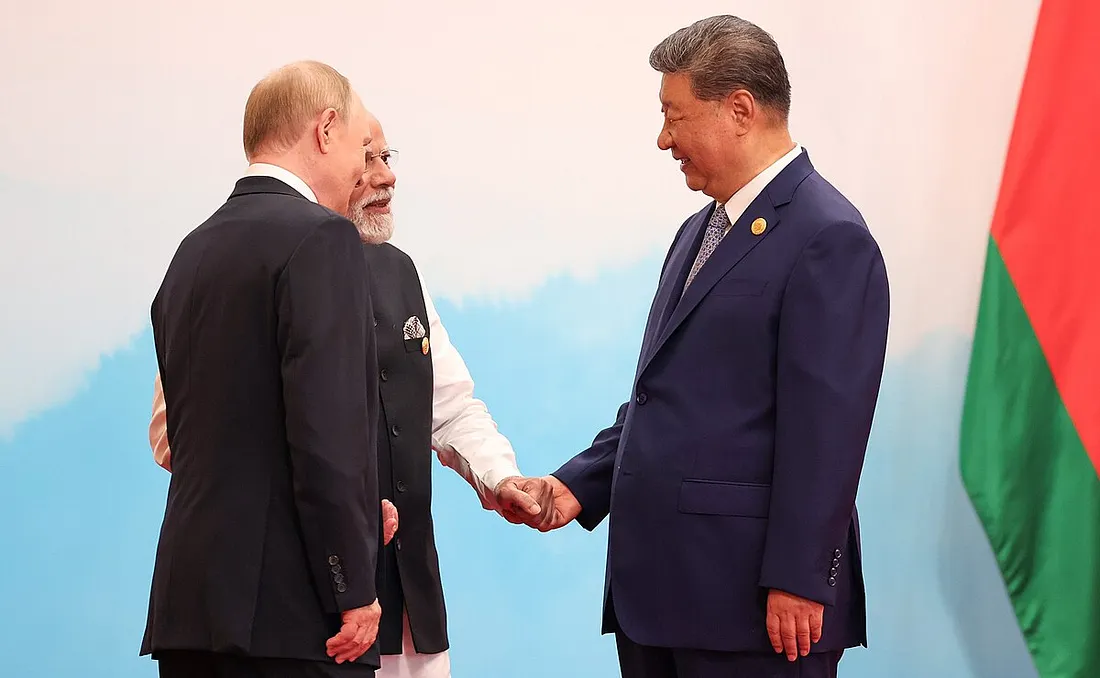
The most recent summit has raised more eyeballs than usual, while the nature of summit is mostly economic. The common meeting among the leaders among India, China, and Russia has brought a certain buzz among western officials. This was primarily due to the remarks of American President Donald Trump’s on Indian leadership who were recently slapped with a tariff of 50% .The decision had caused the Indian administration to rethink its options when considering its trading partners as the country enjoys huge IT related exports to the western power. The imposition of tariffs has put India in a counterbalance in its relation with the US.
The US had earlier accused the South Asian country of funding the Russia Ukraine War through its reselling of crude oil by refining it and selling the resource to the EU and the US itself. This argument had been subsequently dissected by the Indian Ambassador to the UK who had earlier called the western power for its “hypocrisy” as it had accused both EU and the US for its import of Russian uranium hexafluoride for use in its nuclear power industry, palladium, fertilisers and chemicals.
On the other hand, one of the former US ambassadors to India also agree on the matter that India has been unfairly facing tariffs for solely for its import and refinement of Russian Oil. This argument also falls in line which some observers have talked about in regards to the recent development in India-US relations.
China’s Massive Import of Russian Energy Sources
The imposition of tariffs on the south asian power was much lower in comparison to China who has been a major contributor which had been imposed a tariff rate of 35% could partly be due to their dependence on China as a manufacturing hub. In addition to the tariff, China is by far the largest importer of Russian oil worth 11.76 billion USD in oil imports, 2.36 billion USD in pipe gas imports, 1.75 billion USD in coal imports and about 889 million USD in LNG imports as per the data presented in Q2 2025. The graph presented below gives a better picture of the trends presented for all of the mentioned resources.
Pipe gas for one had witnessed a steady growth across all years and rose at a sharper rate especially after the beginning of the ongoing Russian Ukraine conflict in 2022. Furthermore, while China has attempted in decreasing its supply from the federation across all resources, Russia still remains a key supplier for the Eastern power, despite oil imports seeing a steady decline since Q1 2024. It still remains at similar levels to Q1 2022, around the beginning of the kinetic conflict.
While investments from China in the Russian federation have decreased from 1.2 billion $ annually between 2011–2018 to 400 million $ in 2022–23, China’s active investments in the country have decreased by two thirds. The investments are still quite substantial and hence do actively play a role in funding the ongoing war.
Apart from China’s import of Russian energy sources, in the same time span, India, despite being widely accused of funding the war in Ukraine, had imported 10 billion $ in June 2025, which was a decrease of 800 million $ when compared to the previous year of oil imports, which was around 10.8 billion $ in June 2024. This parity of 1.76 billion $ in comparison with that of China highlights the selective double standards showcased by both the EU and US.
Furthermore, the nature of the tariffs combined with the EU’s recent sanctions on India’s oil refinery Nayara for its import of Russian oil through asset freezes, trade restrictions and financial restrictions. The refinery is majority owned by Russian companies such as Rosneft. The sanctions have taken a significant hit on the refinery, which has operated and helped India get around the earlier sanctions of R